
Posted by: Brittany Doering
on June 12, 2026 | 15 min. read
on June 12, 2026 | 15 min. read

You don't find out a supplier can't perform until they don't. By then you're looking at a stopped line, a failed audit, or an emergency call to whoever can ship material this week.
Supplier qualification is how you avoid that. It's the process of vetting a vendor across four areas — lead time reliability, certifications and traceability, processing capability, and communication — before you need them to come through.
This guide gives you a framework for doing it right, including a scorecard you can use to compare suppliers side by side.
Why supplier qualification matters more in 2026
How to evaluate lead time reliability
What certifications should a qualified metal supplier hold?
How to assess a supplier's processing capabilities
What does "good" supplier communication really look like?
The supplier qualifications scorecard
Ready to put a qualified supplier to work?
Between tariff-driven price swings, pressure to source closer to home, and tightening quality requirements on the shop floor, what “good enough” looks like from a supplier has changed. The service center that worked fine last year may not hold up when your next first-article audit lands or your lead time window shrinks.
For buyers managing tariff exposure or shifting sourcing back onshore, the question of where your supplier gets their material, and how reliably they can document it, has gone from a nice-to-have to a contract requirement.
The suppliers worth keeping are the ones who flag problems before you do, confirm lead times in writing, and answer the phone when it matters. A structured supplier qualification process gives you a way to find them before the first order, not after.
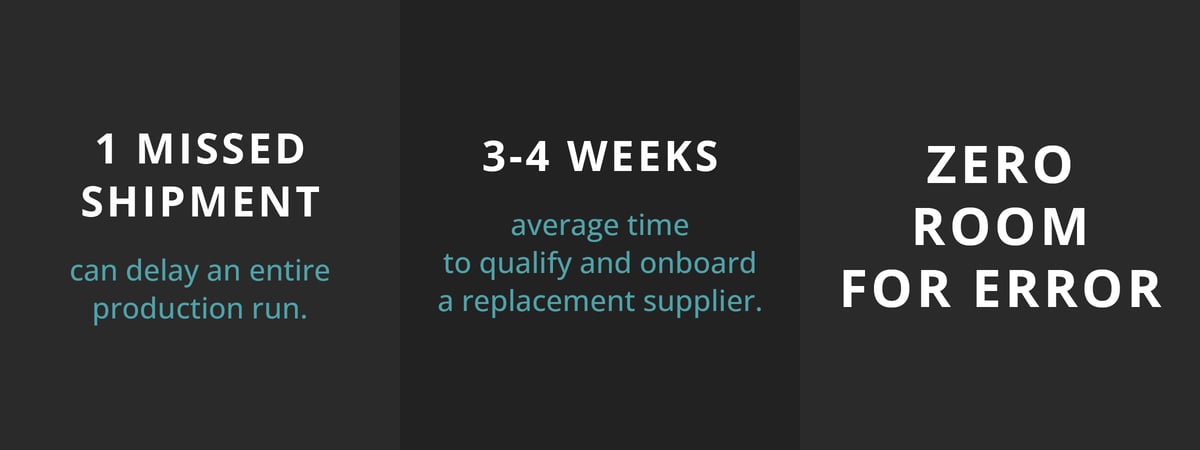
Lead time reliability is the single most operationally disruptive category to get wrong. A supplier who quotes a two-week lead time and ships in four weeks doesn't just delay one order — it cascades through your entire production schedule.
A purchasing manager gets a verbal "two weeks" commitment from a supplier and plans production around it. On day 12, an email arrives with no call and no heads-up, saying there's a delay and material won't ship for another week. The line stops. The escalation starts. That supplier had no documented on-time history to reference, no written acknowledgment, and no proactive process for flagging changes.
The Mead Edge: Speed
Quote confirmed in four hours. Lead time committed in writing at order acknowledgment. If anything changes, you hear from Mead before you have to call. That is the difference between a reactive supplier and one built to operate proactively in a reactive industry.
When evaluating a supplier's lead time reliability, ask:
Look for suppliers who can cite a specific on-time delivery rate, not just a general assurance.
Certifications are not just checkboxes. They signal that a supplier operates under a documented quality management system that has been independently verified by a third party. For industries like aerospace, defense, and medical manufacturing, certain certifications are non-negotiable before a supplier can be approved.
A quality manager at an aerospace sub-contractor requests material test reports from their current steel supplier ahead of an audit. The supplier says they can "probably get them." It takes three days, the documents come back incomplete, and the heat lot number is missing. The audit flags it. The part is put on hold. The supplier had no documented traceability process because no one had ever formalized one.
The Mead Edge: Confidence Built-In
ISO 9001:2015 certified since 1998. AS9100 certified. MTRs provided with every order as a standard part of the process, not pulled together on request, not assembled after the fact. Confidence is built in from the start.
ISO 9001:2015 is the baseline quality management certification for metal service centers. It requires documented processes, internal audits, corrective action protocols, and continuous improvement evidence. A supplier holding ISO 9001 has passed independent third-party verification of their quality management system, reducing your audit burden as a buyer.
AS9100 is the aerospace-specific quality standard built on top of ISO 9001. If you source for aerospace or defense applications, AS9100 certification from your supplier is typically required by the end customer. Verify that the certificate is current and covers the scope of work you’re purchasing.
Beyond certifications, ask how a supplier handles material traceability. A qualified supplier should be able to provide a material test report (MTR), also known as a certified mill test report (CMTR), with every shipment. MTRs document the chemistry, mechanical properties, and heat/lot numbers of the material, giving you chain-of-custody documentation from mill to your dock.
If a supplier cannot provide MTRs on request, that is a disqualifying issue for any regulated or high-consequence application.
Material availability and processing capability are different things. A supplier who stocks steel but cannot slit it to your width, cut it to length, or level flatness tolerances before shipping is not a full-service partner — it’s a warehouse. The more processing a supplier can perform in-house, the fewer handoffs you manage, the fewer quality risks you absorb, and the shorter your total lead time.
A manufacturer orders pre-cut strip steel from a service center. The material arrives as coil; the center had subcontracted the slitting and it came back outside of tolerance. The manufacturer rejects the shipment, scrambles to find replacement material, and absorbs a week of production downtime. The root cause: no accountability for what happened between the original order and the dock.

The Mead Edge:
Fewer Headaches Downstream
Slitting, cut-to-length, leveling, and edge conditioning are all performed in-house at Mead. No subcontractors, no handoffs, no gaps in accountability. Tolerances are held to +/-0.005". One supplier, one point of contact, one place to call if something ever needs to be resolved.
Key processing capabilities to confirm:
Ask whether each of these capabilities is performed in-house or subcontracted. In-house processing gives you tighter quality control, faster turnaround, and a single point of accountability when a spec issue arises.
Communication may be the most underrated qualification criterion — and the one that most accurately predicts your day-to-day working experience. A supplier who is ISO certified and well-stocked but slow to respond and hard to reach will still cost you time and frustration on every single order.
A buyer places an order with a new supplier and hears nothing for 10 days. They call to check status, get transferred twice, and finally learn the order was entered incorrectly. There is no named contact, no order acknowledgment on file, and no visibility into when the material will actually ship. The problem was not the error. Errors happen. The problem was that no one was watching, and no one called.
The Mead Edge: Proactive Partnership
Every Mead customer has a dedicated inside sales rep assigned to their account. Orders are acknowledged in writing. If a timeline shifts, the call comes from Mead — not from you chasing an answer. Proactively delight in a reactive world.
Benchmark communication performance against these standards when qualifying any supplier:
The difference between a reactive and a proactive supplier shows up most clearly when something goes wrong. Ask how a prospective supplier has handled past delivery changes or quality issues. Their answer tells you more than any checklist.
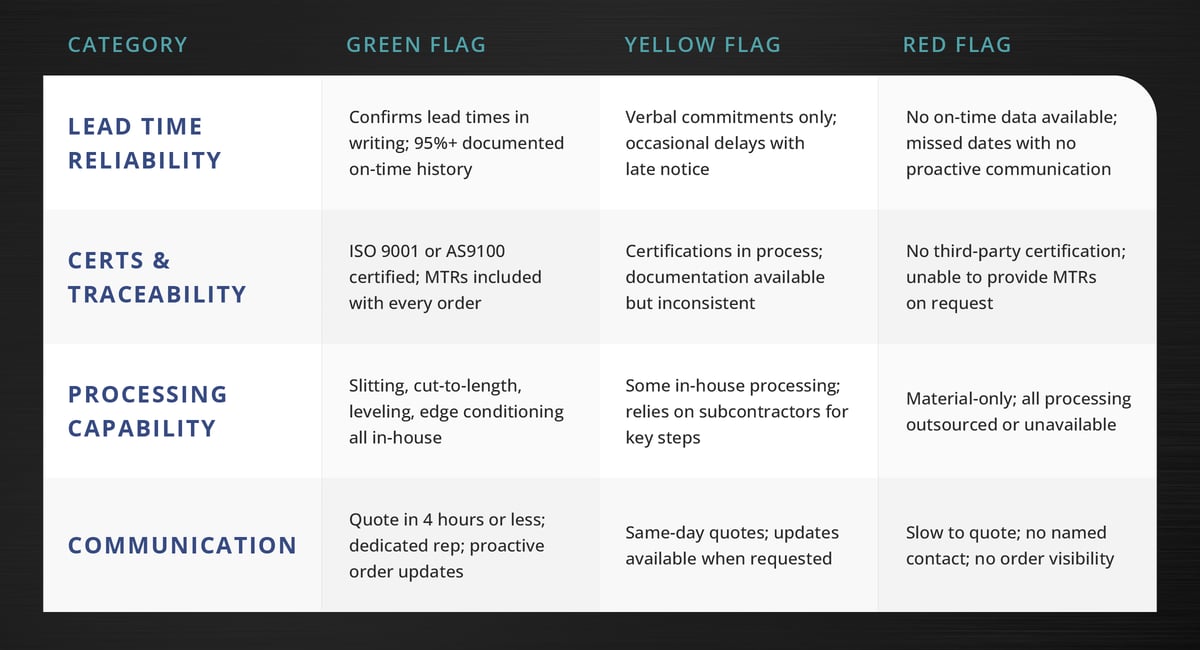
Use the scorecard below to evaluate any metal supplier across all four categories. Each category maps directly to a core Mead Edge differentiator.
The things that make a supplier qualified are the same things that make a supplier worth keeping.
With 60+ years in business and a sales team with nearly 200 years of combined industry experience, Mead has seen what good qualification looks like and built a process around it.
Mead Metals is an ISO 9001:2015 and AS9100 certified specialty metals service center with a 99.8% on-time delivery rate and a four-hour average quote response time. We provide MTRs with every order, process material in-house, and assign a dedicated inside sales rep to every account. Learn more about what makes us different — what we like to call the Mead Edge.
Not ready to commit to a full order? A quick quote is a zero-obligation way to see how Mead responds: lead time, documentation, and communication included.
